This guide to newborn fever will tell you what you should be looking out for and what to do if your newborn baby has a high temperature.
It is important to know what to do if your newborn baby has a fever.
A fever is the body’s way of fighting infections but needn’t be serious. If your baby has a mild fever this may be a sign of usual childhood illnesses. However a high fever, especially in newborns must always be taken seriously.
What Can Cause Newborn Fever
- Infection – This includes viral infections like the common cold. Ear infections are also common in babies.
- Dehydration – If baby has not taken in enough fluids this will cause a rise in temperature.
- Overheating – Baby can get too hot from having too many blankets or many layers of clothing. Avoid placing baby near heaters or in direct sunlight.
Newborn Fever Symptoms
- Skin feels warm and possibly clammy to the touch
- Crying and more fussy than usual
- A change in sleeping pattern. Sleeping a lot more or a lot less than usual
- Problems with feeding. Not wanting to take the bottle or breast
- A temperature of 100.4 degrees Fahrenheit or higher
- A temperature of 97 degrees Fahrenheit or lower. Newborn babies find it difficult to regulate their body temperature so a drop in temperature could indicate a fever

How To Take A Baby’s Temperature
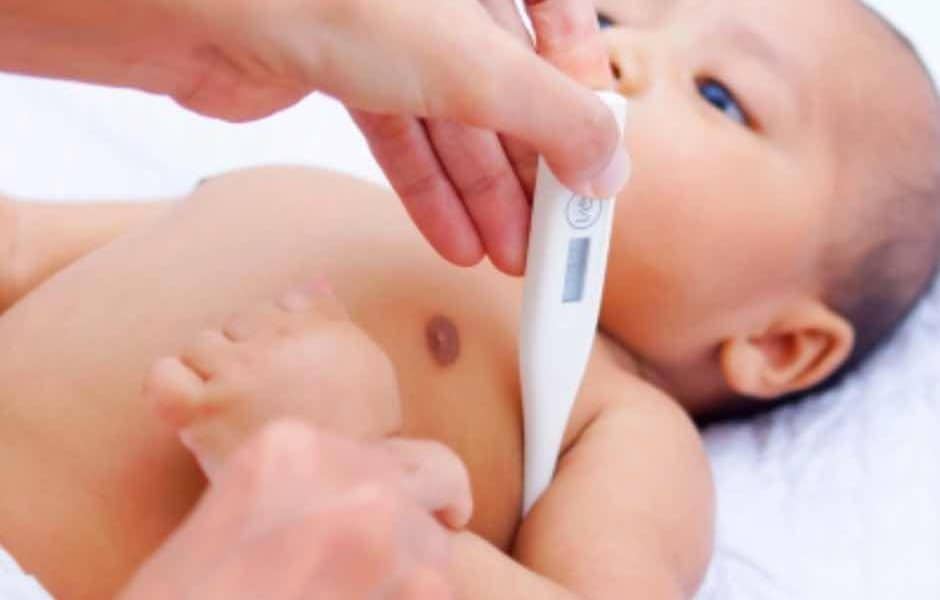
With newborn fever it is important to know the exact temperature of your baby. To get an accurate reading a digital thermometer is considered best.
You can take your baby’s temperature rectally or under their arm (axillary). You won’t be able to take an oral temperature until your child is 4 years old.
It is important that you don’t take your newborns temperature right after a bath or if they have been swaddled. This could give a false reading as baby’s temperature will be elevated for a short time. It is best to wait around 20 minutes before taking their temperature to get a true reading.
Always wash the tip of the thermometer with soap and warm, then rinse with cold water before and after each use.
Your baby may not be happy at having their temperature taken rectally. You could try taking an underarm temperature and if their temperature is above 99 degrees Fahrenheit go ahead and take a rectal temperature.
It will help to lubricate the top of the thermometer with a little petroleum jelly to make it easier to insert. Lay your baby on their back and bend their knees to their chest. Keep talking to baby while you are taking their temperature to help distract them.
Insert the tip of the thermometer into your baby’s rectum until it disappears. This will be about 2cm in. Keep hold of baby to avoid wriggling and don’t let go of the thermometer until it beeps. Always remember to clean the thermometer after use.

What You Can Do If Your Baby Has A High Temperature
- Try to keep your baby as hydrated as possible by giving breast milk or formula regularly. Monitor your baby’s wet diapers and check that their mouths are not dry. These are signs of dehydration.
- Give baby a lukewarm bath or sponge them down with a tepid cloth to help lower temperature. Make sure the water is not too cold as this could cause shivering and may send your baby’s temperature higher.
- Remove excess blankets and make sure your baby is not overdressed.
- Try placing a fan near your baby to help cool them down.
- Continue to check your baby’s temperature at regular intervals.
- If your baby is under 3 months old and has a temperature of 100.4 degrees Fahrenheit then they must be checked out by a doctor. If they are 3 to 6 months old call your doctor if their temperature reaches 102 degrees Fahrenheit.
There are symptoms that may be present with fever in a newborn or baby that could be a sign of something more serious.
Call a doctor immediately if your baby has any of these symptoms along with a fever.
- Becoming extremely sleepy
- Vomiting
- Diarrhoea
- A seizure
- A rash that cannot be explained
- Showing any signs of difficulty breathing
You might also like.